December 2025
WoF Review
This page provides an overview of the Government’s proposed changes to the Warrant of Fitness (WoF), their potential impact and MTA’s response on behalf of members.
The Government has proposed changes to the Warrant of Fitness (WoF) that could have significant implications for both industry and the public.
MTA is making a detailed submission on the changes based on member feedback.
This page contains details of what is proposed and our response.
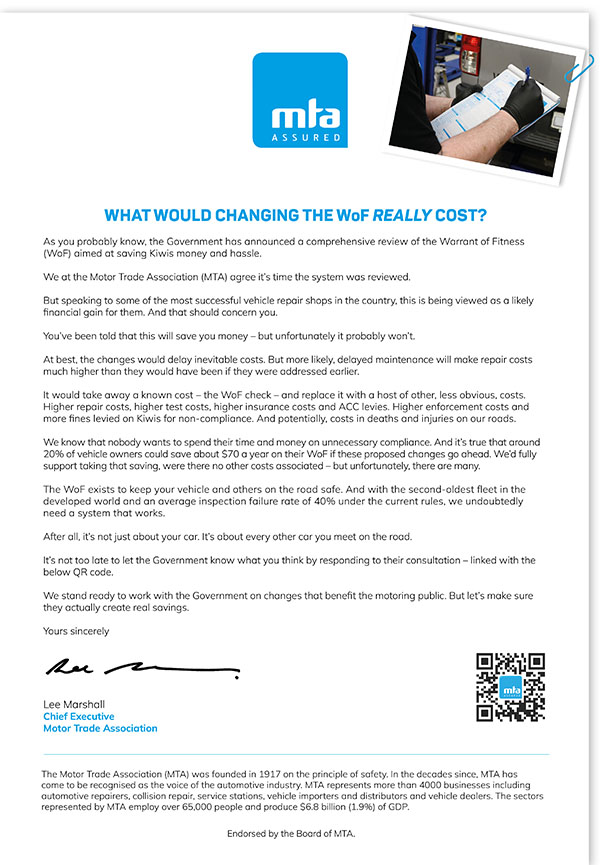
On Monday 15 December, MTA placed notices in newspapers around the country outlining some of our concerns in brief. You can see a copy here.
Below are links to other information you may find useful. We will update this page regularly.
MTA welcomes all feedback from motorists and members. Please contact James McDowall if you would like to send us your thoughts.
What it could mean for you
MTA supports modernising New Zealand’s vehicle inspection regime. Our focus is safety first, while keeping costs down for motorists. This is a critical issue for us – MTA members provide up to 80% of the country’s vehicle inspections.
The Government is consulting on changes to the WoF regime – in many cases doubling the time between inspections.
We’re concerned about the safety impacts and some of the assumptions underpinning the proposals, but we’ll engage constructively to improve them.
Bottom line: modernise – yes; but do it in a way that keeps people safe and avoids false savings that turn into bigger repair bills later.
What could change
- First WoF for new vehicles extended to four years (currently three)
- Vehicles aged four to 10 years moved to two‑yearly WoFs
- Light‑touch ADAS check – a visual check to confirm no warning/fault lights are active (if the vehicle has these modern features)
- Stronger enforcement and public education around ongoing vehicle maintenance.
Before you skip a WoF, what to consider
- Longer gaps mean more risk. Unseen wear on tyres, brakes, steering and suspension worsens when checks are delayed.
- Beware of false savings. Skipping a WoF might save an inspection fee (roughly $70), but small issues can turn into bigger, costlier repairs that dwarf that saving.
- ADAS isn’t a substitute. A warning‑light check helps, but it doesn’t prove those systems are working or calibrated and it can’t replace proper mechanical safety checks.
- To the Government: involve the people who see it daily. Inspectors and workshops are the ones checking and fixing vehicles on New Zealand’s roads. Bring industry in to get the settings right.
What we’re calling for
Keep the first WoF at three years – newer vehicles often rack up high mileage early; the three‑year checkpoint is already late for picking up tyre and brake wear.
Shorten the proposed two‑yearly band – move vehicles to annual WoFs by seven years (rather than ten) to better match real‑world risk – a practical 3–2–2–1 schedule.
Make ADAS checks meaningful – go beyond fault lights, with clear guidance and training for inspectors, and be transparent about any cost implications.
Roll changes out with the public – sequence implementation with strong public education and a practical, detailed enforcement plan published for consultation.
Be honest about costs – longer intervals can increase repair severity and lift households’ total spend over time.
Target higher‑risk vehicles – enable more detailed inspections for older and/or high‑mileage vehicles, e.g. wheels‑off brake checks and practical suspension performance tests.
Our letter outlining some of MTA's concerns is below and available here to view >>
Why it matters
Skipping a yearly check doesn’t stop wear and tear – it lets it progress. With twice as long between inspections, unseen issues in tyres, brakes, steering and suspension have longer to deteriorate. Tyres creep towards the legal limit, brake pads can score rotors, and suspension parts loosen. Many drivers won’t notice these until something goes wrong, or when they finally realise that their brake lights haven’t been working for almost two years.
International context – why caution is sensible
United Kingdom: After consultation, the Government kept the MOT schedule at 3 years, then annually.
European Union: In April 2025 the European Commission proposed modernising periodic testing, including ADAS checks. In December 2025, EU ministers kept the current minimum test frequencies while the issue is looked at in more detail.
Have your say and keep in touch
Share feedback via NZTA’s consultation hub (closing 17 December 2025).
Talk to your local MTA member workshop or inspector about how longer intervals may affect your vehicle and budget.
Let us know your thoughts by emailing [email protected]
FAQs
Are tyre rules changing?
Nothing has been proposed, but MTA is making the case for a change. If a WoF is to be granted for two years, it is very unsafe to be passing tyres that have 1.6mm of tread left. At the very least, a bald tyre can cause a sudden loss of control, or at worst a full blowout at high speed.
Does an ADAS check mean vehicles require these systems?
No. The ADAS check only applies to vehicles that have factory fitted systems.
Are these changes basically a done deal?
Not yet, but motorists need to have their voices heard on these important changes, whether they fully or partially agree or disagree. We encourage everyone to have their say.
“These changes are presented as a cost‑of‑living saving for Kiwis. Some might save on a skipped WoF, but many will end up paying more in larger maintenance and repair bills, insurance impacts, and the taxpayer will wear higher enforcement and education costs. We’re keen to modernise the system, but we need to do it safely and with credible data – and with industry at the table.” Lee Marshall, Chief Executive, MTA